Revise

Gradients, Tangents and Normals
Gradients, Tangents and Normals
As mentioned in the Differentiation section, we can find a derivative to give the gradient of a graph at any given point.
From that information, we can create a tangent and a normal.


A Level Maths Predicted Papers 2025
The MME A level maths predicted papers are an excellent way to practise, using authentic exam style questions that are unique to our papers. Our examiners have studied A level maths past papers to develop predicted A level maths exam questions in an authentic exam format. The profit from every pack is reinvested into making free content on MME, which benefits millions of learners across the country.
View Product
A-A* A Level Maths Practice Papers
The MME A-A* A level maths practice papers are excellent for those top achieving students to practise for their exams, using authentic exam style questions that are unique to our practice papers. Our content experts have studied A level maths past papers and specifications to develop specific A-A* A level maths exam questions in an authentic exam style. The profit from every pack is reinvested into making free content on MME, which benefits millions of learners across the country.
View ProductHow to Compare the Tangent and Normal
Let’s denote the gradient of the tangent m_T and gradient of the normal m_N.
For a pair of tangent and normal lines at one point, we have one rule:
The two must be perpendicular.
This means that we must have
m_T\cdot m_N = -1

Example 1: Finding the Tangent
A tangent is a straight line which touches our graph, but doesn’t pass through it at the meeting point. By definition, a straight line graph (i.e. y = x) cannot have a tangent – only a curved graph can have a tangent.
So, as an example, here’s the graph of \textcolor{blue}{y = (x - 1)^2 - 2}. Find the equation of the tangent line at x = \dfrac{3}{2}.
[4 marks]
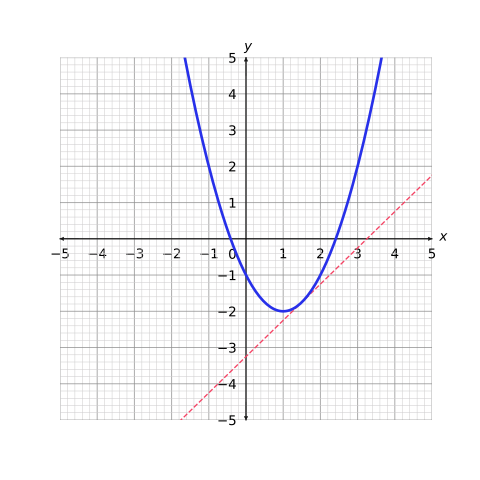
To find the tangent, we first find the gradient at our point of interest.
Since we have
\textcolor{blue}{y = (x - 1)^2 - 2}
= \textcolor{blue}{x^2 - 2x - 1}
we have a gradient of
\dfrac{dy}{dx} = 2x - 2
at any point, and \dfrac{dy}{dx} = 1 when x = \dfrac{3}{2}.
Since our gradient is a straight line, it must have the general equation
y = mx + c
When x = \dfrac{3}{2}, y = -\dfrac{7}{4} and \dfrac{dy}{dx} = m_T = 1.
Then we can plug in these values to find c:
-\dfrac{7}{4} = \dfrac{3}{2} + c
c = -\dfrac{7}{4} - \dfrac{3}{2} = -\dfrac{13}{4}
Therefore, our tangent to y = (x - 1)^2 - 2 at x = \dfrac{3}{2} is given by the equation \textcolor{red}{y = x - \dfrac{13}{4}}.
Example 2: Finding the Normal
The normal is a straight line which is exactly perpendicular to the tangent.
Say we have the same graph from Example 1, but now we wish to find the normal at the point x = \dfrac{3}{2}.
[3 marks]
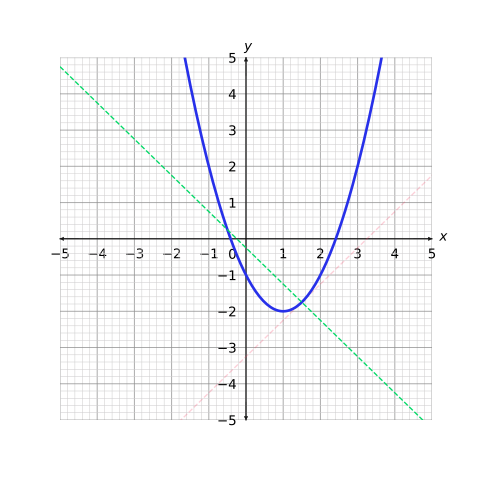
Since we already know that the gradient of the tangent, m_T = 1, we can conclude that the gradient of the normal, m_N = -1.
Given, also, that the point of interest is at \left( \dfrac{3}{2}, -\dfrac{7}{4} \right), we can form a straight line equation for the normal:
-\dfrac{7}{4} = \left(-1 \times \dfrac{3}{2} \right) + c
c = -\dfrac{7}{4} + \dfrac{3}{2} = -\dfrac{1}{4}
The equation of the normal is given by \textcolor{limegreen}{y = -x - \dfrac{1}{4}}.
Gradients, Tangents and Normals Example Questions
Question 1: What is the gradient of the tangent and the normal at x = 2 for the equation f(x) = -x^2?
[2 marks]
f(x) = -x^2 gives f'(x) = -2x
When x = 2,
m_T = -4 and m_N = \dfrac{-1}{-4} = \dfrac{1}{4}


Question 2: Find the tangent to the equation y = x^3 at x = 1. Verify, also, that this tangent runs parallel to the tangent at x = -1.
[5 marks]
y = x^3 gives a gradient of
\dfrac{dy}{dx} = 3x^2
When x = 1,
\dfrac{dy}{dx} = 3 and y = 1
Then
1 = (3 \times 1) + c
c = 1 - 3 = -2
The equation of the tangent at x = 1 is y = 3x - 2.
At x = -1, \dfrac{dy}{dx} = 3 \times (-1)^2 = 3.
Therefore, we can see that the gradients of the tangents at x = 1 and x = -1 are the same, so the two must run parallel.
Question 3: Given that the derivative of y = \sqrt{x + 4} is given by \dfrac{1}{2\sqrt{x + 4}}, show that the normal at x = -\dfrac{1}{2} passes through the origin.
[5 marks]
When x = \dfrac{-1}{2}, y = \sqrt{\dfrac{7}{2}}.
We have m_T = \dfrac{1}{2\sqrt{\dfrac{7}{2}}} = \dfrac{1}{\sqrt{14}}. Then m_N = -2\sqrt{\dfrac{7}{2}} = -\sqrt{14}.
y = mx + c gives
\sqrt{\dfrac{7}{2}} = \left( -\sqrt{14} \times \dfrac{-1}{2} \right) + c
\sqrt{\dfrac{7}{2}} = \sqrt{\dfrac{14}{4}} + c
\sqrt{\dfrac{7}{2}} = \sqrt{\dfrac{7}{2}} + c
c = 0
So, the normal intercepts the y-axis at y = 0, or, more appropriately, the origin.

Specification Points Covered
G1 – Understand and use the derivative of f(x) as the gradient of the tangent to the graph of y=f(x) at a general point (x,y); the gradient of the tangent as a limit; interpretation as a rate of change; sketching the gradient function for a given curve; second derivatives; differentiation from first principles for small positive integer powers of x
G3 – Apply differentiation to find gradients, tangents and normals, maxima and minima and stationary points, points of inflection