Revise

Inverse Trig Functions
Inverse Trig Functions
We’ve mentioned a little bit about the inverse trig functions already, but now it’s time to take a look at how their graphs look.
We have:
- known as
- known as
- known as


A Level Maths Predicted Papers 2025
The MME A level maths predicted papers are an excellent way to practise, using authentic exam style questions that are unique to our papers. Our examiners have studied A level maths past papers to develop predicted A level maths exam questions in an authentic exam format. The profit from every pack is reinvested into making free content on MME, which benefits millions of learners across the country.
View Product
A-A* A Level Maths Practice Papers
The MME A-A* A level maths practice papers are excellent for those top achieving students to practise for their exams, using authentic exam style questions that are unique to our practice papers. Our content experts have studied A level maths past papers and specifications to develop specific A-A* A level maths exam questions in an authentic exam style. The profit from every pack is reinvested into making free content on MME, which benefits millions of learners across the country.
View ProductSetting up the Inversion
Just before we begin, we need to remember that the , and graphs are not one-to-one functions, they are many-to-one functions. We have a set of values which give back the same result.
For example, we have
A function can only have an inverse if it is one-to-one. As a result, we’ll need to restrict the domain (the range of values of ) of each original trig graph to be one-to-one:
- is restricted to
- is restricted to
- is restricted to
- The range of is unrestricted
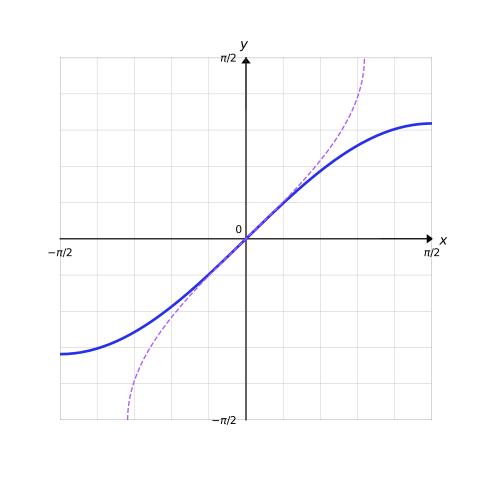
Here’s the graph, along with …
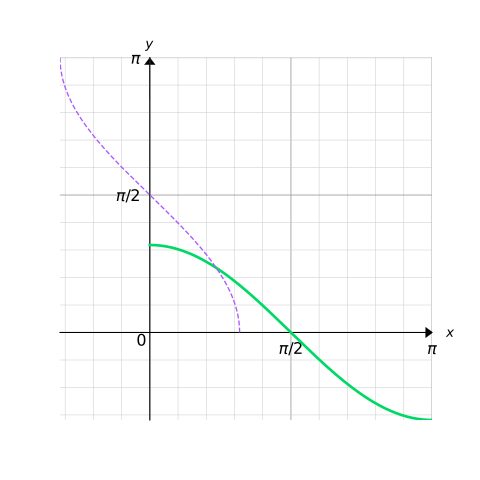
… and now the graph, along with …
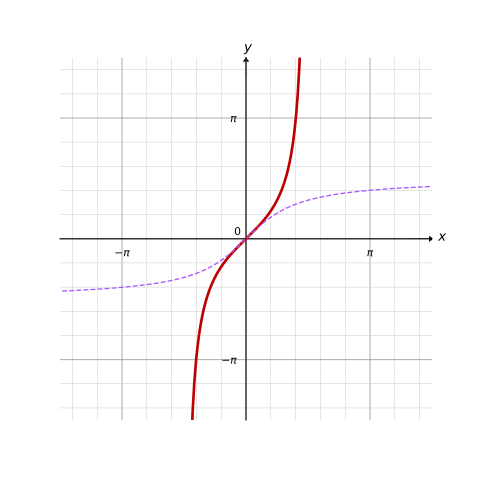
… and the graph, along with .
Note:
Inverse trig functions are NOT the same as the reciprocal trig functions.
So,
Inverse Representation in Graphical Form
Actually, you might have noticed that the inverse function is the original function reflected in the line .
This is true for any inverse function, but this is probably a good time to mention it anyway.
Inverse Trig Functions Example Questions
Question 1: Give the exact value of in radians.
[1 mark]


Question 2: Give the exact value of in radians.
[1 mark]
Question 3: Give the exact value of in radians.
[1 mark]

Specification Points Covered
E4 – Understand and use the definitions of secant, cosecant and cotangent and of , and ; their relationships to sine, cosine and tangent; understanding of their graphs; their ranges and domains
