Revise

Reciprocal Trig Functions
Reciprocal Trig Functions
Remember how we said that , and aren’t quite the same as , and ? Here’s why…


A Level Maths Predicted Papers 2025
The MME A level maths predicted papers are an excellent way to practise, using authentic exam style questions that are unique to our papers. Our examiners have studied A level maths past papers to develop predicted A level maths exam questions in an authentic exam format. The profit from every pack is reinvested into making free content on MME, which benefits millions of learners across the country.
View Product
A-A* A Level Maths Practice Papers
The MME A-A* A level maths practice papers are excellent for those top achieving students to practise for their exams, using authentic exam style questions that are unique to our practice papers. Our content experts have studied A level maths past papers and specifications to develop specific A-A* A level maths exam questions in an authentic exam style. The profit from every pack is reinvested into making free content on MME, which benefits millions of learners across the country.
View ProductIntroducing , and
We have three definitions, now:
- Cosecant:
- Secant:
- Cotangent:
We’ve given these three reciprocal functions a special name so we don’t get them confused with the inverse functions.
The easiest way to remember which is which, is to look at the third letter of each function, so, Cosecant , Secant and Cotangent .

In Graphical Form
Now, we’ll represent the graph of :
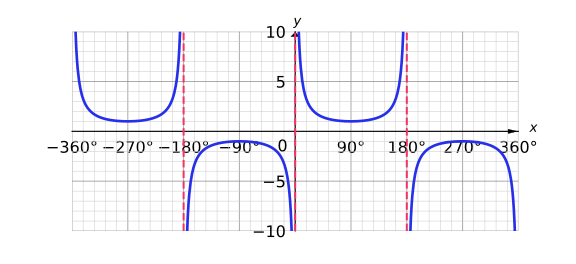
Notice how there are now asymptotes at .
Well, , so it will not have values where , i.e. where .
Notice, also, how there are no values between and . Think on that for a while…
Anyway, here’s the graph for :
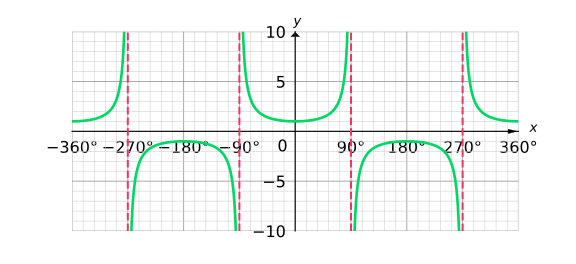
See how the asymptotes are now at . Again, this is because we’ll find that at these points.
Again, there are no values between and
To complete the set, here’s :
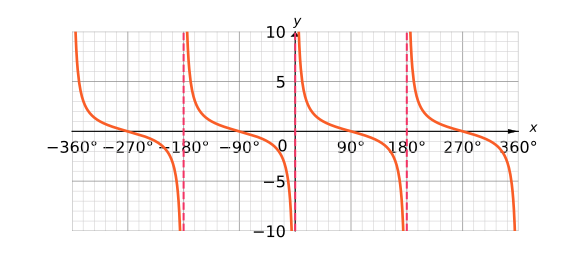
This time, there are no undefined values for , but we do have vertical asymptotes at again.
Domains, Ranges and Key Values
You might want to reference from this table of ranges and domains:


and here’s some key points that you might need to know.
In case you were wondering, means the value is between but not including and .
Reciprocal Trig Functions Example Questions
Question 1: Solve for all values of in the range .
[2 marks]
means that , which has solutions at .


Question 2: Briefly explain why and have no values in the range .
[2 marks]
and .
Since and have a minimum of and maximum of , we conclude that and have a positive minimum of , and a negative maximum of .
To have or between and , we require or to be greater than , or less than , which is not possible.
Question 3: Solve for .
[3 marks]
Rewrite this as
We can rearrange to get
This gives

Specification Points Covered
E4 – Understand and use the definitions of secant, cosecant and cotangent and of arcsin, arccos and arctan; their relationships to sine, cosine and tangent; understanding of their graphs; their ranges and domains