Revise

Trig Equations
Trig Equations
Solving the basic trig equations is pretty easy, but what happens if we’ve got a function which has been stretched or translated?
Make sure you are happy with the following topics before continuing.


A Level Maths Predicted Papers 2025
The MME A level maths predicted papers are an excellent way to practise, using authentic exam style questions that are unique to our papers. Our examiners have studied A level maths past papers to develop predicted A level maths exam questions in an authentic exam format. The profit from every pack is reinvested into making free content on MME, which benefits millions of learners across the country.
View Product
A-A* A Level Maths Practice Papers
The MME A-A* A level maths practice papers are excellent for those top achieving students to practise for their exams, using authentic exam style questions that are unique to our practice papers. Our content experts have studied A level maths past papers and specifications to develop specific A-A* A level maths exam questions in an authentic exam style. The profit from every pack is reinvested into making free content on MME, which benefits millions of learners across the country.
View Product
Inspection
First, we need to find an initial solution.
So, for example, let’s say we want to find the values of when .
We want to draw the graph, and mark on a horizontal line where the condition is met, i.e. where .
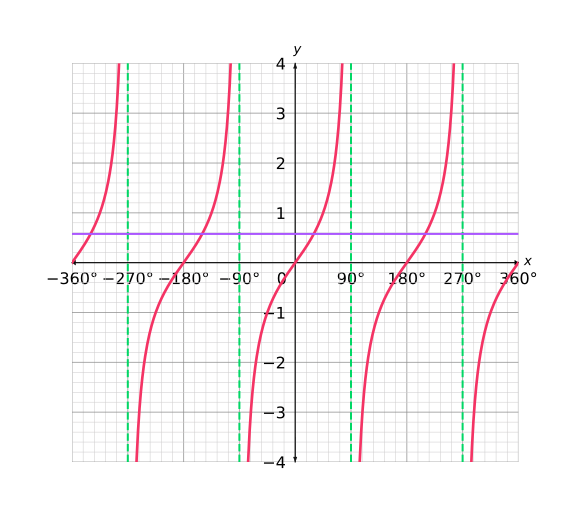
By inspection, we know that the initial solution is at , and we can see it repeats at every .
We’ll denote this .
CAST Diagrams
The CAST diagram is a handy tool to show us where values of the standard trig functions are positive.

So, here’s the breakdown:
- For , ALL of and are positive
- For , ONLY is positive
- For , ONLY is positive
- For , ONLY is positive
Think back to plotting the Unit Circle, in the Trig Basics section.
Let’s say we want to find the values of such that , as before.
We know that there is a solution when .
First, we plot the point on the diagram, then find the corresponding angles:

From here, we can see that when or , or, more concisely, .
We ignored the two solutions where is not positive, i.e. and .
Dealing With Trig Transformations
Transformations pose a little bit of a problem… See, CAST diagrams become much harder to navigate now. You’re much better off sketching out the function and solving using the horizontal line technique.
So, let’s just begin with an example.
We have . Find the values of * such that .
* This is just set notation, meaning
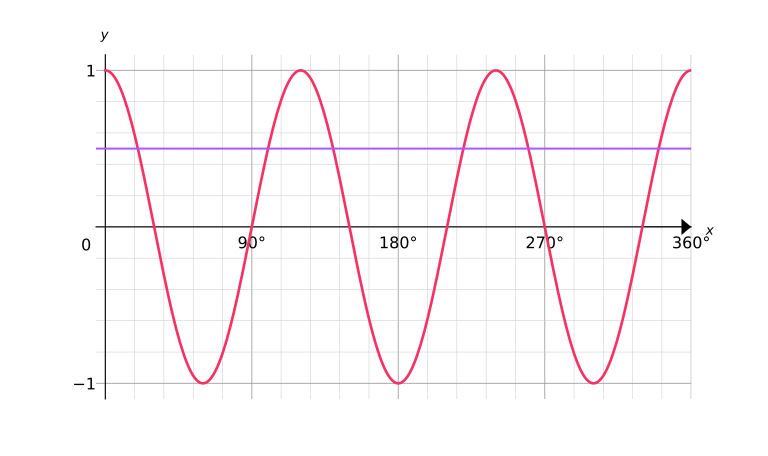
Well, we have a series of solutions, but they’re not immediately obvious.
What we can do instead is plot the regular graph on an interval three times as large as the proposed interval, and divide our solutions there by .
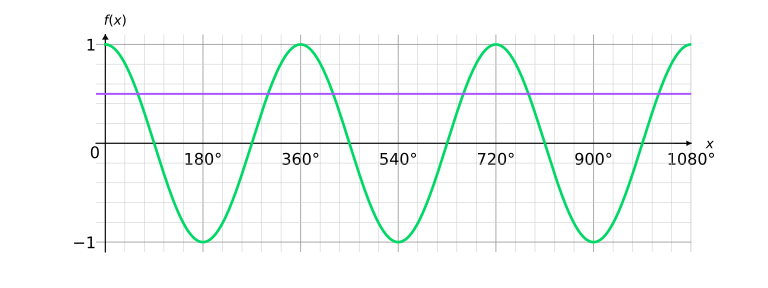
has solutions .
Therefore, has solutions .
Trig Equations Example Questions
Question 1: Sketch the graph and by inspection, find the solutions of , in the interval .
[2 marks]



Question 2: Using a CAST diagram, find the values of such that .
[2 marks]
gives .
 By the CAST diagram, we can see that we also have a solution where .
Question 3: For , find the values of where .
[4 marks]
For , we want .
If we look for values of where , and multiply our values of by a scale factor of , we have our new set of solutions.
occurs at
Therefore the solution of is .
Specification Points Covered
E7 – Solve simple trigonometric equations in a given interval, including quadratic equations in sin, cos and tan and equations involving multiples of the unknown angle
E9 – Use trigonometric functions to solve problems in context, including problems involving vectors, kinematics and forces
Trig Equations Worksheet and Example Questions

Sin cos and tan
A Level
Related Topics